Why East Point Homes Are Prone to Water Damage (Blame the Red Clay)
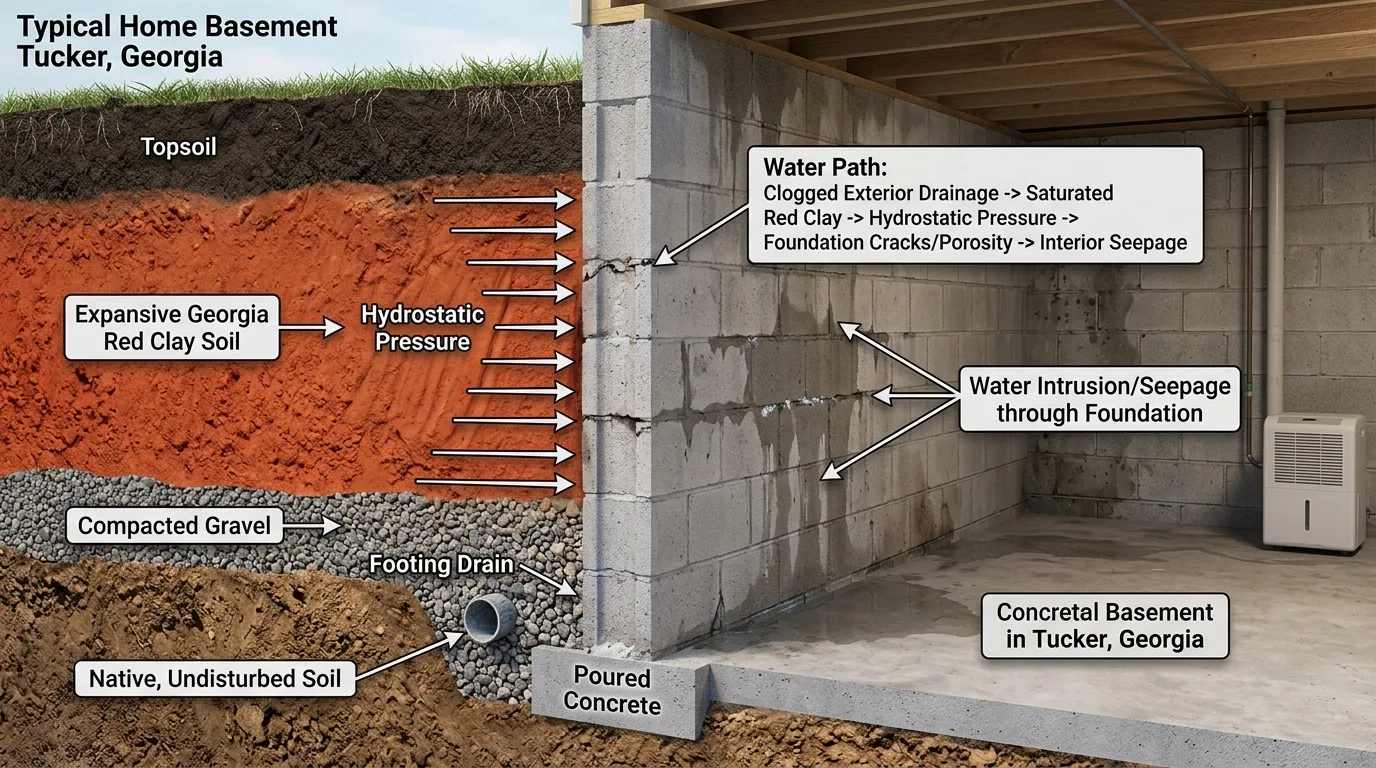
Beneath the lawns of Colonial Hills, Cherry Blossom, and neighborhoods throughout East Point lies a soil type that actively works against residential foundations — expansive Georgia red clay. Most homeowners don’t think about what’s under their home until water starts appearing in their basement or crawlspace, but in East Point, the soil itself is one of the primary drivers of chronic water intrusion. This post covers why Georgia red clay creates persistent water damage risk, which neighborhoods are most affected, and what homeowners can do about it. In this post, we cover how clay soil mechanics work, the relationship between soil and foundation water entry, local neighborhoods most at risk, and prevention strategies.
Water Intrusion in Your East Point Home?
IICRC-certified inspection and water damage restoration throughout East Point and Fulton County. Call (877) 698-1311.
Why Red Clay Soil Creates Persistent Water Damage Risk
Georgia red clay is what geologists call an expansive soil — it absorbs water and swells significantly when wet, then contracts and shrinks when dry. Fulton County’s red clay can expand up to 10% in volume when fully saturated. That swelling creates enormous lateral and upward pressure against foundation walls and slabs. When the clay dries out during drought conditions, it shrinks away from the foundation, leaving gaps that allow groundwater to pool against the structure during the next wet cycle.
This seasonal swelling and shrinking is relentless. Over years and decades, the repeated expansion-contraction cycle causes hairline cracks in concrete block and poured concrete foundations to widen progressively. Each crack becomes a water intrusion pathway. During East Point’s spring and summer storm season, when rainfall events can deliver 2–4 inches in a matter of hours, groundwater moves rapidly along these clay-soil pathways directly toward foundation cracks.
The pattern repeats every year, and it accelerates as foundations age. Homes built in the 1930s–1960s — common throughout East Point — were typically built without the modern drainage engineering, waterproofing membranes, or interior drain tile systems that newer construction uses to manage expansive soil conditions. These older structures are significantly more vulnerable than newer homes built with clay-compatible foundation design.
Which East Point Neighborhoods Are Most Affected
The impact of red clay soil is not uniform across East Point. Neighborhoods built in the mid-century period on relatively flat terrain with older drainage infrastructure face the highest risk.
Cherry Blossom: Historic downtown area with ranch and colonial homes averaging around $281,000. The oldest housing stock in East Point, built before modern drainage engineering. Basement and crawlspace water intrusion following heavy rain events is a recurring pattern in this neighborhood.
Colonial Hills: Craftsman bungalows built in the 1930s–1950s with basement and crawlspace foundations. Unity Park serves as a landmark near the neighborhood’s center. The combination of older foundations, clay soil, and bungalow construction makes this one of East Point’s highest-risk areas for foundation water intrusion.
DeLowe-Connally: Located near Connally Nature Park and Sumner Park, this neighborhood features a mix of housing ages with many mid-century structures. Proximity to natural drainage features increases groundwater pressure during heavy rain events.
Center Park: A mix of vintage and newer homes near Main Street, with older structures sharing the same red clay foundation risk. The neighborhood’s proximity to MARTA creates additional infrastructure that affects local drainage patterns.
Found Water in Your East Point Basement or Crawlspace?
We identify the source and restore completely. Serving East Point, Hapeville, College Park, and all of Fulton County. Call (877) 698-1311.
How Clay Soil and Humidity Combine to Accelerate Damage
The clay soil problem doesn’t occur in isolation — it interacts with East Point’s humid subtropical climate to create conditions that amplify water damage when intrusion occurs. Once water enters through a foundation crack opened by clay movement, it encounters a building environment where the average relative humidity is already 67% year-round. Saturated building materials — wood framing, insulation, drywall — don’t dry naturally in this environment at a rate that prevents mold growth. Without mechanical dehumidification, moisture from a foundation intrusion event can persist for weeks.
East Point averages over 50 inches of annual rainfall — substantially above the national average — which means the clay soil rarely fully dries out between wet periods. The “dry” phase that causes clay shrinkage and foundation gap formation typically occurs in October–November, the city’s driest season. By late fall, foundations may have new gaps opened by summer shrinkage that haven’t yet been infiltrated by water. When winter rain and spring storms arrive, those gaps become active entry points.
This cyclical pattern explains why many East Point homeowners experience recurring water intrusion in the same areas year after year. The gap doesn’t stay repaired because the clay keeps moving. Without addressing both the foundation crack and the underlying drainage around the foundation, water damage restoration addresses the symptom without solving the cause.
What Homeowners Can Do to Reduce Risk
Understanding the clay soil risk doesn’t mean you’re helpless. Several interventions significantly reduce water intrusion risk in East Point’s expansive soil conditions. Proper grading away from the foundation — 6 inches of drop over the first 10 feet — directs surface runoff away from foundation walls rather than toward them. Extending downspouts 4–6 feet away from the structure prevents roof runoff from concentrating against the foundation.
Interior drain tile systems and sump pumps provide active water management for homes that have chronic basement intrusion despite exterior drainage improvements. For crawlspace foundations common in the Cherry Blossom and Colonial Hills areas, encapsulation with a vapor barrier reduces the ground moisture that clay soil transfers upward into the crawlspace environment.
For homes that have already experienced water intrusion, prompt professional restoration is essential before secondary damage compounds. See our complete guide to water damage restoration in East Point and our overview of flood damage cleanup services in East Point.
Cost Factors Related to Clay Soil Water Damage
Across Fulton County, clay-soil-related water intrusion tends to generate higher average restoration costs than plumbing-failure events because the source is ongoing rather than single-event. Without source correction, restoration is a recurring cost. Georgia water damage restoration averages $3,814, but chronic foundation intrusion events that affect finished basements or crawlspace framing can reach $10,000 or more when structural drying, mold remediation, and material replacement are combined. See our detailed water damage restoration cost guide for East Point.
Frequently Asked Questions
Does homeowner insurance cover clay-soil water intrusion in East Point?
Standard homeowner insurance typically does not cover water damage from gradual foundation water entry related to soil conditions — this is classified as a maintenance issue or earth movement. However, if the intrusion is sudden and related to a specific storm event, coverage may apply depending on your policy language. We document the timing and cause of each intrusion event to support the strongest possible claim. See our insurance claim assistance services.
Can clay-soil foundation cracks be permanently repaired?
Foundation cracks caused by expansive clay can be sealed and stabilized, but the underlying soil movement continues. Carbon fiber straps, epoxy injection, and interior drain tile systems provide long-term management rather than a permanent fix. We recommend a foundation specialist assessment alongside water damage restoration for homes with chronic clay-related intrusion.
How do I know if my East Point home has clay-soil water risk?
The clearest signs are recurring water staining at the base of foundation walls, efflorescence (white mineral deposits) on concrete block walls, and musty smells in the basement or crawlspace after rain events. If your home in Cherry Blossom, Colonial Hills, or a similar East Point neighborhood was built before 1970, assume clay-soil risk is present and have a drainage assessment performed.
Water Damage in Your East Point Home?
We restore completely and document everything for your insurance claim. Call (877) 698-1311 for 24/7 service in East Point and Fulton County.
Related: